
How to Build Production-Ready Vision AI for Pickleball Skill Evaluation
To build a production-ready computer vision app for real-world sports training, we engineered a complete Vision AI pipeline that translates pose estimation into reliable coaching intelligence. PlayerU's platform now delivers automated skill evaluation for pickleball techniques with 80% frame-level accuracy, <10 second feedback latency, and zero false positives, enabling affordable, scalable coaching for
19.8 million recreational players.
Through a phased approach, from core serve evaluation to overhead hit mastery, Ardas team evolved a research-stage concept into a market-ready product built to scale with player demand and sport expansion.
Technical stack includes:
- Backend: Node.js, NestJS, Auth0, PostgreSQL, pg Vector
- Frontend: React Native (mobile), Next.js (web dashboard)
- Vision/ML: EyePop.ai SDK, Custom scoring algorithms, Vector database
- Infrastructure: AWS (ECS, ECR, CloudWatch), Structured logging
- Integration: ListenNotes API (content), n8n (workflow automation)
- Testing: Jest, Cypress, Load testing (NBomber)
- Architecture: Microservices-ready, Event-driven, Clean Architecture, CQRS-ready
Our Client
PlayerU is a South Florida sports tech startup building AI-powered training for recreational pickleball. The market is massive, but most players lack access to affordable, personalized coaching.
PlayerU solves this with video-based AI analysis that evaluates form objectively and delivers drilling recommendations. The vision: make expert coaching accessible to every recreational player.
Initial Client's Challenges
-
Precision requirement: 80% frame-level accuracy for pass/fail decisions — no tolerance for false positives
-
Video variability: Players record from different angles, with varying lighting, skill levels, and shot speeds
-
Technique complexity: Evaluating continental grip, weight distribution, spin mechanics, and footwork requires models fine-tuned to pickleball's specific motion patterns
-
Scaling feedback: Users needed insights into where their form breaks down, not just pass/fail scores
-
Production readiness: Translating computer vision outputs into reliable scoring logic, where most Vision AI projects stall
Project-Based Team
To address the gap between research-stage Vision AI and production-ready systems, we deployed a focused team of 2 engineers, 1 PM and 1 BA.
They built the complete pipeline, from EyePop.ai integration to proprietary scoring algorithms to AWS infrastructure, capable of handling real-world video variance and delivering coaching intelligence at scale.
The challenge wasn't the computer vision model. It was everything around it: reliable scoring logic, edge-case handling, real-time monitoring, and the infrastructure to iterate safely.
Development Stages
-
Phase 1: Serve skill evaluation MVP: Core Vision AI pipeline, EyePop.ai integration, production infrastructure
-
Phase 2: Overhead hit evaluation + optimization: Form complexity expansion, latency optimization, analytics dashboard
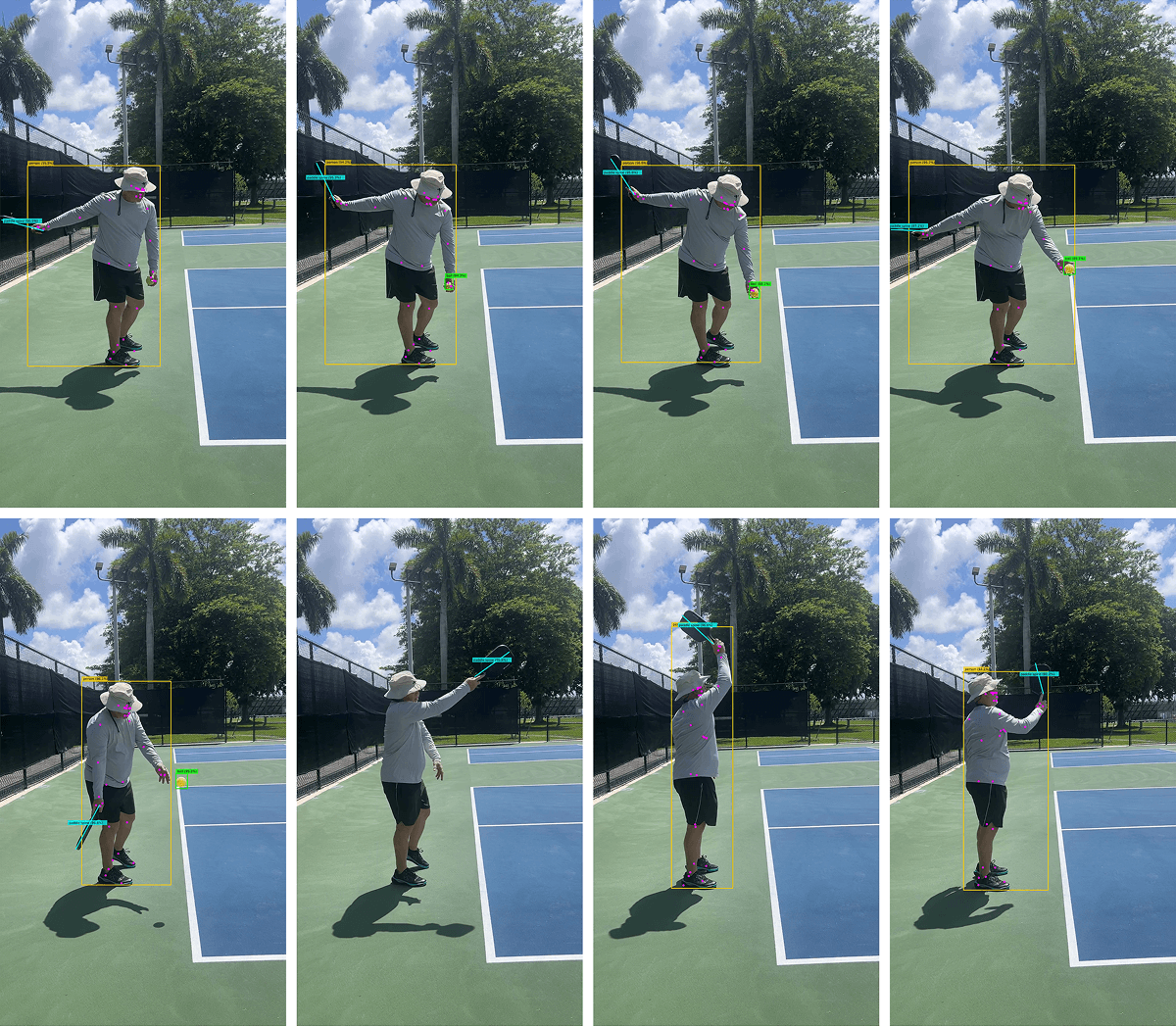
Solution
- Computer Vision Architecture: Production-grade system using EyePop.ai for pose estimation and movement analysis
- End-to-End Video Processing Pipeline: Async video processing for <10 second feedback without blocking the mobile app
- Proprietary Scoring Algorithms: Custom form-evaluation logic translating 80+ pose points per frame into coaching intelligence
- AWS Infrastructure & Monitoring: ECS/ECR containerization, CloudWatch alerting, structured observability for production reliability
Key Product Features
- Serve Skill Evaluation Video analysis with pass/fail + form quality scores. Pinpoints exact frames where technique breaks down. Players see: "your weight shift is too late on frame 23."
- Overhead Hit Evaluation: Form assessment for complex overhead mechanics. Extended in Phase 2 with same rigor as serve, adapted for motion complexity.
- Form Insights & Drilling Recommendations: Beyond scoring. The system identifies weak form elements and suggests drilling priorities. A player might pass overall but have weak weight distribution — the app flags it and recommends specific drills.
- Progression Tracking: Weekly improvement metrics. Did your weight shift timing improve? Is your grip angle more consistent? Data visualization makes progress visible, driving retention.
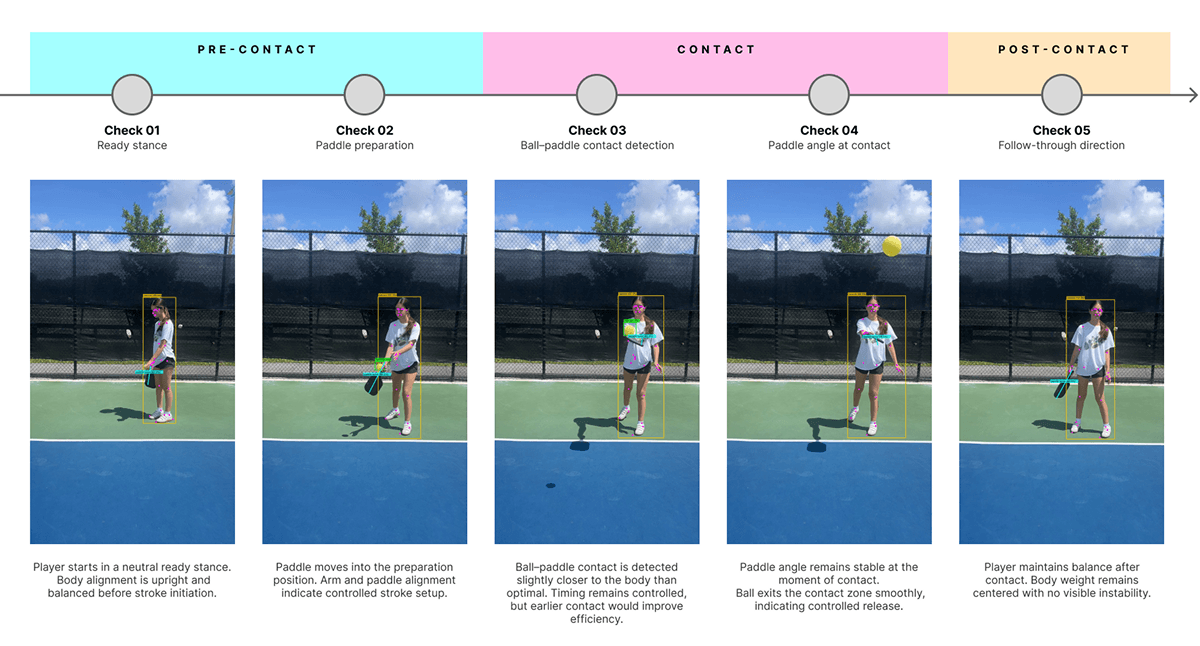
Delivered Results: Phase 1
-
Production-ready backend with EyePop.ai integration
-
Serve skill evaluation algorithm (v1) tested and validated on 1,000+ player videos
-
Full CloudWatch monitoring and alerting pipeline with structured logging
-
Mobile app integration for video capture and real-time feedback display
-
MVP ready for user testing and early traction
Delivered Results: Phase 2
- Overhead hit skill evaluation live and validated
- Optimized video processing pipeline (reduced latency by 40%)
- Extended analytics dashboard for coach/player progression tracking
- Refined scoring models based on real player data (1,000+ videos analyzed)
Impact for Client’s Business by the Numbers
- 80% frame-level accuracy achieved (exceeding initial requirement)
- <10 second feedback latency — players get instant results
- 1,000+ player videos analyzed in validation phase
- Scalable to 10+ sports techniques — architecture proven modular
- Zero false positives on serve evaluation (production requirement met)
FAQ
What accuracy threshold is required for real-world Vision AI applications?
For coaching/feedback applications, 80%+ frame-level accuracy is industry standard. This allows pass/fail decisions without false positives that frustrate users. But accuracy alone isn't enough—your scoring logic must be explainable. If the AI says "pass," a coach should understand why.
How do you handle video variance in computer vision applications?
Real-world video varies by angle, lighting, camera quality, and subject movement. Three approaches: (1) collect diverse training data, (2) build processing pipelines that normalize inputs before analysis, (3) implement fallback logic when confidence drops below threshold. All three are required for production systems. This is exactly the layer Ardas builds for sports tech clients — the input-normalization pipeline and confidence-based fallbacks are where most consumer Vision AI projects break, and where we focus first.
What infrastructure is needed to deploy Vision AI for consumer apps?
Cloud-native architecture with async processing (don't block the app), structured monitoring (know when the model fails), and versioning strategy (roll out new models safely). Most teams skip this and regret it when models degrade in production. Ardas builds this infrastructure layer as standard — async processing, structured monitoring, and model versioning are baked into how we ship, backed by ISO 9001 and ISO 27001 certification and 20+ AI products running in production.
How do you iterate on Vision AI scoring logic without breaking production?
Implement blue-green deployments for models, A/B testing frameworks for algorithm changes, and canary releases (deploy to 5% of traffic first). Version your models and maintain rollback capability. Never push directly to production.
Why should sports tech companies partner with Ardas for Vision AI?
Vision AI is infrastructure-heavy. It's not about finding the right model—it's about building the pipeline, monitoring, versioning, and scaling logic around it. Ardas has shipped 20+ AI products in production, holds ISO 9001 and ISO 27001 certification, and clients keep 100% IP with no vendor lock-in. We know where things break and how to prevent it. Talk to our team: ardas-it.com/contact-us
Get Insights from Real SaaS Builds
Enjoyed the read? We write these case studies and articles to share what works — and what doesn’t — in real SaaS delivery. Got a challenge of your own? Let’s talk tech.

Ryzhokhin