
How to Talk to Your Board About AI
When You Are the One Who Understands It


Key insights
- Board skepticism about AI updates is typically a translation issue, not a trust issue. Boards are concerned with ambiguity, not the technology itself.
- Every board question about AI can be distilled into three core concerns: Is this safe? What is the actual risk if it fails? What are the consequences of inaction?
- Technical metrics such as model accuracy or sprint velocity are not meaningful at the board level. Instead, use production trust level, blast radius, and time to detect.
- Effective technical leaders translate technical statements into business consequences without altering the underlying facts.
- When asked "why isn't this faster," an effective response acknowledges the pressure, identifies the tradeoff, and returns the decision to the board.
- A one-page update covering status, risk, required decisions, and tradeoffs reduces ambiguity and shortens board meetings.
Your team knows exactly where the AI initiative stands. You know which pipeline is production-ready, which one is still fragile, and which decision is actually blocking progress. Then you walk into the board meeting, give an honest update, and get a question that has nothing to do with what you just said: "But is this actually working?"
That gap isn't a sign the board doesn't get it. It's a sign of a ‘translation problem’.
"We shipped the retrieval pipeline" and "is this safe to bet the quarter on" are two different languages, and most AI updates fail at the board level not from lack of progress, but from lack of translation.
Working with post-PMF and scaling businesses for more than 2 decades, Ardas team knows how to improve your communication with non-tech C-level, starting with the digital modernization phase to effective AI adoption.
This isn't a guide to building your AI program. This guide explains it for the technical leader who already knows what's true and needs the board to know it too.
The Real Communication Gap
Boards don't distrust AI. They distrust ambiguity. A board member has no reliable way to tell "we're 80% done and on track" apart from "we're stuck and don't fully know it yet" — both can sound identical in a status update full of technical detail.The instinct under that pressure is to explain harder: more detail, more technical grounding, more proof of competence. But that usually makes it worse.
The board isn't asking you to prove you're capable. They're asking for a confidence signal they can actually act on.
That’s the real CTO job in a board update: not demonstrating progress, but giving the board something they can decide with — speaking their (business) language.
In our experience running AI adoption programs alongside technical teams, this translation gap — not model performance — is the actual bottleneck most companies hit first.
Three Questions the Board Is Actually Asking
As per our observation and tight communication with non-tech executives, whatever the literal question is, it usually decomposes into three:
Is this safe?
Not “does the model perform well” — safe for the business if it’s wrong.
What’s the actual risk if it fails?
Not a hypothetical. A specific answer: what breaks, who notices, how fast.
What happens if we do nothing?
The actual cost of possible delay, stated as plainly as the cost of shipping.
If your update doesn't answer these three, it doesn't matter how technically thorough it was. So, structure every AI update around these questions explicitly, even if nobody asked them directly.
Replace Technical Metrics With Business Ones
Model accuracy, PRs merged, sprint velocity - these are real signals, but they don't translate. A non-tech board member has no framework for whether 94% accuracy is reassuring or alarming.
Swap them for metrics that carry their own meaning:
| Instead of... | Report... |
|---|---|
| Model Accuracy | Production trust level: can this run unsupervised, or does it still need a human checking every output? |
| Sprint Velocity | Blast radius if wrong: how much of the business does a failure actually touch? |
| Bugs found in QA | Time to detect: how long before we'd know if this broke in production? |
| "We' re moving fast" | Cost of delay vs. cost of shipping now: stated as an actual tradeoff, not a mood |
None of these require dumbing down the engineering. They require answering a different question than the one the team is used to being asked.
At enterprise scale, the blast-radius question in particular gets sharper - one failure can touch thousands of accounts instead of a handful, so naming it explicitly matters even more.
The CTO's Translation Habit
The best technical leaders develop a specific habit: they translate the true technical statement into its business consequence, without losing accuracy in either direction.
A few simple yet effective examples from Ardas team:
| Instead of... | Report... |
|---|---|
| "we added a verification gate" | "we can now catch a bad decision before it reaches a customer, not after." |
| "we're running human-in-the-loop review" | "nothing ships to production without someone accountable for it — that hasn't changed." |
| "the pilot hit 80% accuracy" | "four times out of five it gets this right on its own; the fifth time, a person catches it before the customer ever sees it." |
| "we're still in discovery" | "we're making sure we're building the right thing before we spend the budget building it — this is the cheapest phase to get wrong." |
Each of these is still exactly true. Neither version overclaims.
The difference is which consequence gets named out loud - the same discipline we build into our AI development work itself, just pointed at a different audience.
Handling "Why Isn't This Faster"
All right, this is where most technical leaders get defensive, over-explain, or quietly absorb the pressure and speed up in ways that later cause exactly the incidents the board is worried about.
A better pattern has three moves:
Acknowledge the pressure is legitimate
Speed is a real business concern. Competitors are moving. Don’t dismiss it — name it.
Name the actual tradeoff being asked about
Make the choice concrete: what shipping faster actually costs vs. what waiting actually protects.
Hand the decision back explicitly
Rather than making it silently. Skipping governance isn’t free — someone chooses that, on purpose, with the tradeoff visible.
“I hear that the timeline matters — competitors are moving. Here’s the actual tradeoff: we can ship in three weeks with less verification, or six weeks with full production monitoring in place. If we ship faster, an undetected failure could reach customers before we catch it."
That’s a real choice, and it’s yours to make with that information — not a technical limitation on our end.
This does two things at once. It respects that speed is a legitimate business pressure, and it makes clear that skipping governance isn't free - someone chose that, on purpose, with the tradeoff visible.
A One-Page Board Update Template
The actual translation habit worth building is a format, not a speech.
A single page, every time, with four sections:
- Status — one sentence, plain language, no caveats buried in qualifiers.
- Risk — what could go wrong, and what happens if it does.
- Decision needed — the specific choice the board is being asked to make, if any.
- What changes if we choose X vs. Y — the tradeoff, stated in business terms, not technical ones.
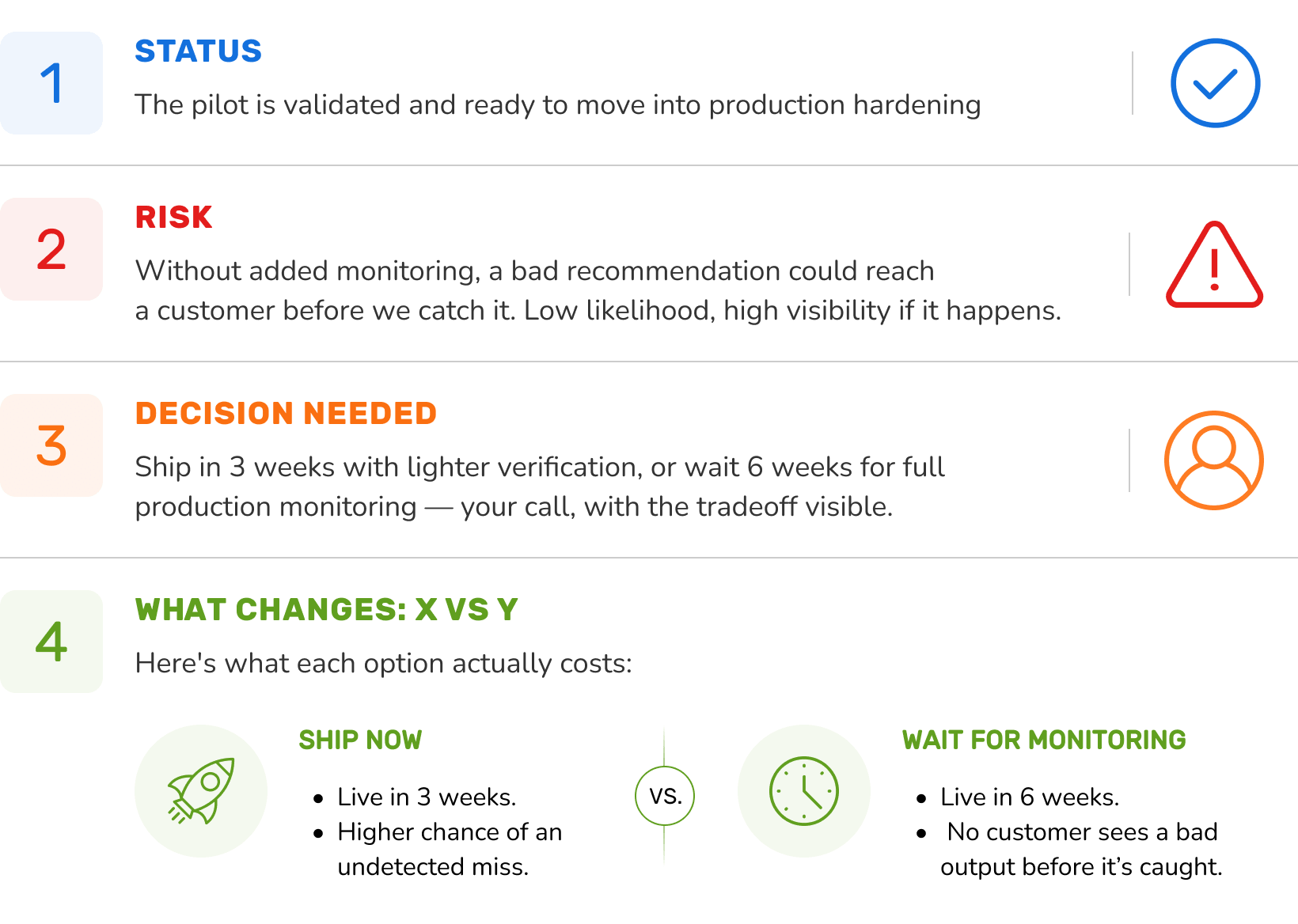
Tech teams we work with and that adopt this consistently report the same effect: board meetings get shorter, not longer, because the ambiguity that used to eat the discussion time is answered before anyone has to ask.
The Real Skill Being Built
Once again, none of this is about hiding complexity or making things sound simpler than they are. It's the opposite.
It's making sure the true state of things actually lands, instead of getting lost in a level of detail the room can't act on. The technical team's job in a board update isn't to convince the board that AI works.
In most cases, they already believe that.
The job is to give them enough clarity to make one real decision — and that's a communication skill, not an engineering one. Worth building on purpose, the same way you'd build any other operating discipline.
If your team is technically strong but the board conversation keeps stalling on trust, that's usually a translation gap, not a delivery gap — and for CTOs especially, it's fixable faster than most people expect.
Not sure where the trust breaks down — team, process, or reporting?
That's usually the first thing we help clients pin down. Worth a 20-minute conversation.
Talk to UsFAQ
Why does my board keep questioning an AI update that's actually on track?
Board members have no reliable way to tell an update that's 80% done and on track apart from one that's stuck and doesn't know it yet — both can sound identical when they're full of technical detail. The board isn't questioning your competence; they're asking for a confidence signal they can actually act on.
What three questions is a board really asking about an AI initiative?
Whatever the literal question is, it usually decomposes into three: is this safe for the business if it's wrong, what specifically breaks if it fails and how fast would anyone notice, and what does it cost the business to do nothing. Structuring an update around these three, even unprompted, answers what the board is actually asking.
What should I report to the board instead of model accuracy?
Swap technical metrics for ones that carry their own meaning: production trust level instead of accuracy, blast radius instead of sprint velocity, time to detect instead of bugs found in QA, and cost of delay versus cost of shipping instead of a general sense that the team is moving fast.
How do I answer "why isn't this faster" without sounding defensive?
Acknowledge that the pressure is legitimate, name the actual tradeoff being asked about, and hand the decision back to the board explicitly rather than absorbing it silently. This respects that speed is a real business pressure while making clear that skipping verification isn't free — someone is choosing that, on purpose, with the risk visible.
What does "translating" a technical update into business language actually look like?
It means stating the same true fact through its consequence rather than its mechanism — saying "we can catch a bad decision before it reaches a customer" instead of "we added a verification gate," without overclaiming in either direction. The technical statement and the business statement should both remain exactly true.
What is "blast radius," and why does a board care about it?
Blast radius is how much of the business a failure actually touches if the AI system gets something wrong. At enterprise scale, a single failure can reach thousands of accounts instead of a handful, which is why naming this number explicitly matters more as a company grows.
How long should a board update on AI actually be?
One page, every time, with four sections: status in one plain sentence, risk and what happens if it materializes, the specific decision being asked of the board if any, and what changes between the available options stated as a business tradeoff. Teams that adopt this format report shorter meetings, not longer ones.
Does simplifying an AI update for the board mean hiding its real complexity?
No — the goal is the opposite of hiding complexity. It's making sure the true state of the initiative actually lands with the room, instead of getting lost in a level of technical detail the board has no framework to act on.
How does Ardas help technical leaders close this gap?
Ardas has spent more than two decades working alongside post-PMF and scaling companies, and our AI consulting engagements often start exactly at this translation gap between technical teams and non-technical executives. If your team is technically strong but board conversations keep stalling on trust rather than progress, talk to our team about closing that gap.