
Building Vision AI into Production Products: A Real Story

From Prototype to Production: Deploying Vision AI at Scale
Key Insights
- Real-world Vision AI success — This case demonstrates how computer vision moves beyond prototypes into production for sports skill evaluation.
- Scalable video analytics deliver coach-grade insights — AI video analysis transforms raw footage into measurable performance feedback.
- Computer vision suited to rich motion sports — Sports with dynamic and varied movement (e.g., pickleball) benefit strongly from automated video interpretation.
- Accuracy and edge-case handling are core challenges — High‑precision pose evaluation and robust feedback logic are critical for reliable outputs.
- Production-ready Vision AI needs full pipeline engineering — Beyond models: integration layers, monitoring, scoring logic, and latency optimization matter.
- Vision AI unlocks new business value in sports tech — Automated training feedback and skill progression insights extend product utility and user engagement.
This case study examines how we deployed the client’s AI-powered video-analysis system to accelerate skill development in pickleball, not just by tracking performance, but by turning footage into actionable intelligence: reducing unforced errors, personalizing training drills, and providing scalable feedback loops for players and coaches alike.
If you’d like the background on how this collaboration started, you can read the full partnership announcement here.
The sport of pickleball has grown from a backyard pastime into a full-blown movement, and for good reason. It blends the accessibility of ping-pong with the athleticism of tennis, making it easy to start and hard to master. In the U.S. alone, the numbers speak for themselves.
The AI sport is now widely cited as America’s fastest-growing, with participation skyrocketing by more than 300 % over three years, reaching nearly 19.8 million players in 2024. Average player age is dropping (now around 35 years), and younger demographics are engaging in the sport in increasing numbers.
Why does AI matter for modern sport?
When a sport scales so rapidly, the demand for performance improvement, coaching sophistication, and analytics grows right alongside it. Players no longer accept “just play and enjoy”. They want measurable improvement, real insights, and effective training tools.
At the same time, the broader sports-technology market is shifting dramatically. Advanced analytics, computer vision, and AI-powered video systems are no longer reserved for pro football or basketball—they’re penetrating club sports, recreational leagues, and individual athlete training.
This shift also reflects a broader change we’re seeing across industries: computer vision is moving from a risky, research-heavy initiative into a repeatable, production-ready capability that can directly support revenue and user value. We recently explored this transition in more detail here.
For instance, the global “AI in Sports” market is projected to grow from roughly US$2.9 billion in 2024 to upwards of US$11 billion by 2033, driven by demand for real-time insights, video analysis, and performance optimization.
In this environment, pickleball presents particularly powerful business opportunities:
- Fast-growing participation and an expanding base of mid- to high-skill players hungry for improvement;
- A sport with rich visual motion (paddles, ball-tracking, footwork) is suited to video-based analytics;
- A market is still early in its analytics maturity, which means early adopters can gain a competitive edge.
Pickleball training and skill assessment tool
About the client.
PlayerU is a South Florida-based sports technology startup. The company is building a mobile-first training platform specifically designed for recreational pickleball players—targeting the "99 percenters" who want to improve their game without tournament-level coaching expenses.
PlayerU positions itself at the intersection of sports education and accessible AI technology in America's fastest-growing sport. We are helping to develop a mobile app for pickleball players, focused on improving individual technique through AI-powered video analysis. From Beginner to Intermediate level, and beyond.
The app enables players to record and upload videos of themselves practicing core pickleball skills. Using computer vision (CV), the system automatically evaluates their form and provides pass/fail feedback based on predefined coaching criteria.
Key techniques evaluated:
- Stance and weight distribution — for stability and shot readiness
- Continental grip — critical for control during serves, and returns
- Serve and return serve mechanics
- Overhead hits and lobs
- Spin application and control
Each skill is evaluated using a weighted scoring model. Key movements carry higher point values, while secondary movements contribute less. After scoring all movements, we calculate the total percentage of points earned. A skill is considered a “pass” when the athlete scores at least 80% of the maximum possible points.
What challenges do this pickleball training app face without AI video analysis?
- Final stretch complexity: While the core app is nearly finished, accurately translating EyePop.ai outputs into pass/fail logic across diverse player videos remains a challenge.
- High accuracy required: A “pass” requires proper form in 80% of video frames — demanding high precision from both the CV layer and the evaluation algorithms.
- Technique-specific nuances: Evaluating complex elements like proper continental grip, stance during spin shots, and weight distribution during overhead hits requires models fine-tuned to pickleball’s unique movements.
- Edge-case handling: Variability in video quality, player skill level, and shot speed means the system must handle edge cases gracefully without false positives or negatives.
- Scalable feedback: The client wants to move beyond simple pass/fail to offer players meaningful insights — e.g. where their form breaks down during a lob — to support real skill improvement.
How does AI video analysis app works for pickleball skill assessment
- Video Capture: An app User records short clips of specific techniques from a set position
- Processing: Videos are uploaded and analyzed using EyePop.ai’s CV platform
This platform makes it easy for any team to integrate computer vision — no machine learning expertise or extra team needed. With straightforward SDK calls, teams can analyze images, video, or live streams using pre-built models or quickly train custom ones with just a few clicks.
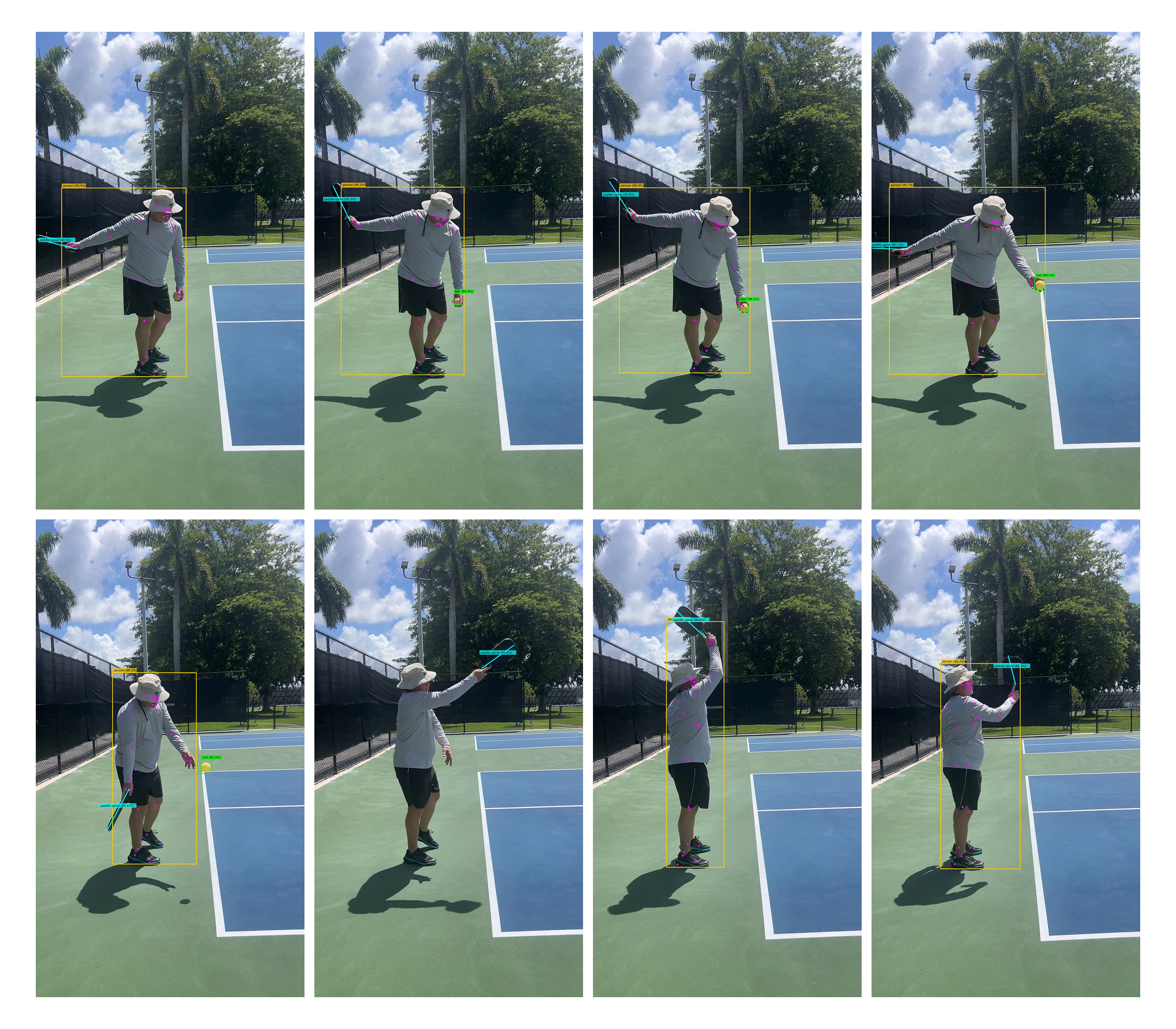
Note: For faster and smoother vision model optimization, it’s important that the User record initial videos of the recommended length, from the right angle and position, clearly capturing the target objects. High-quality data makes all the difference.
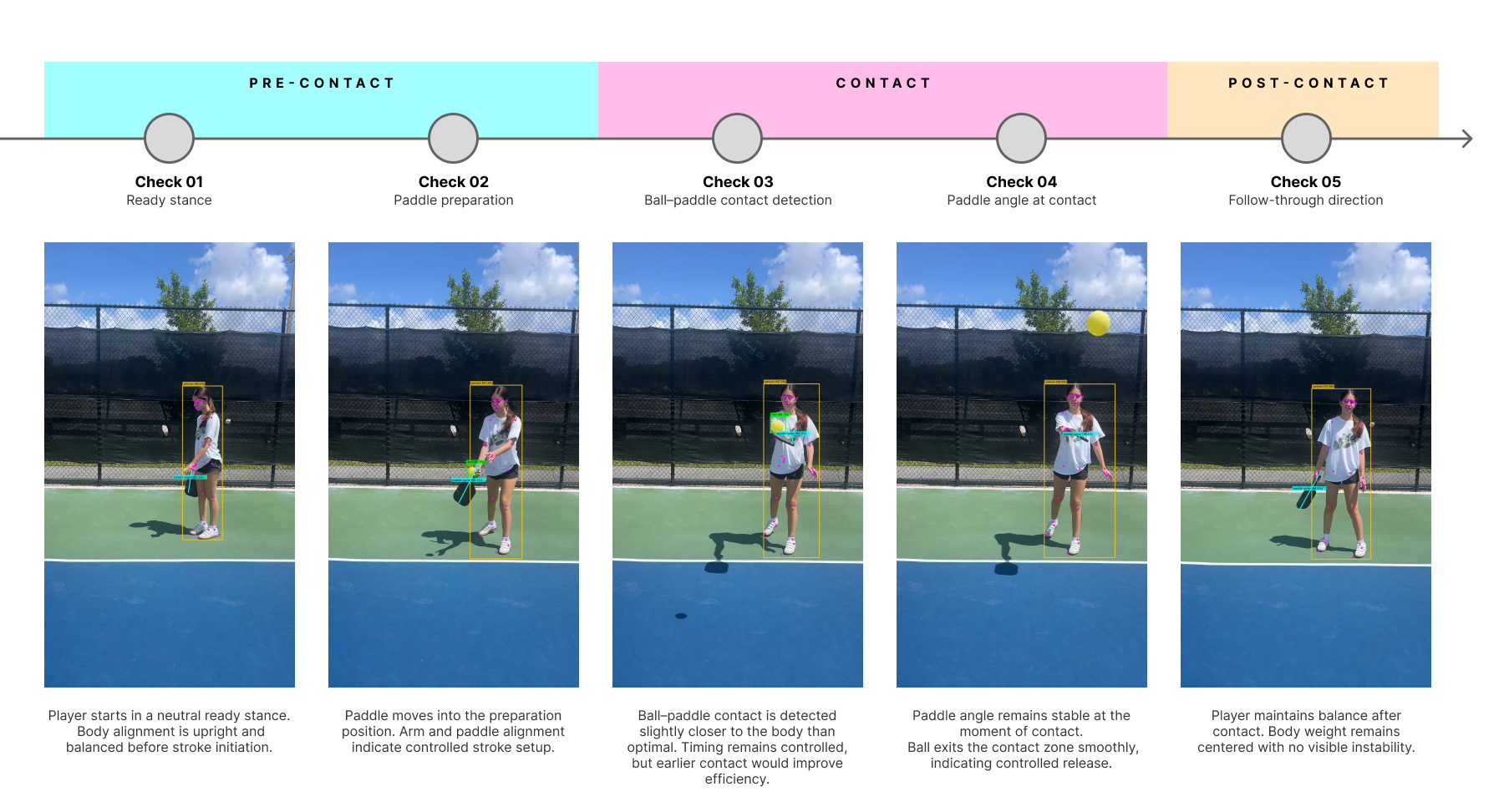
- Form Analysis: Custom post-processing algorithms interpret structured CV data to assess technique vs. predefined coaching standards (hero examples)
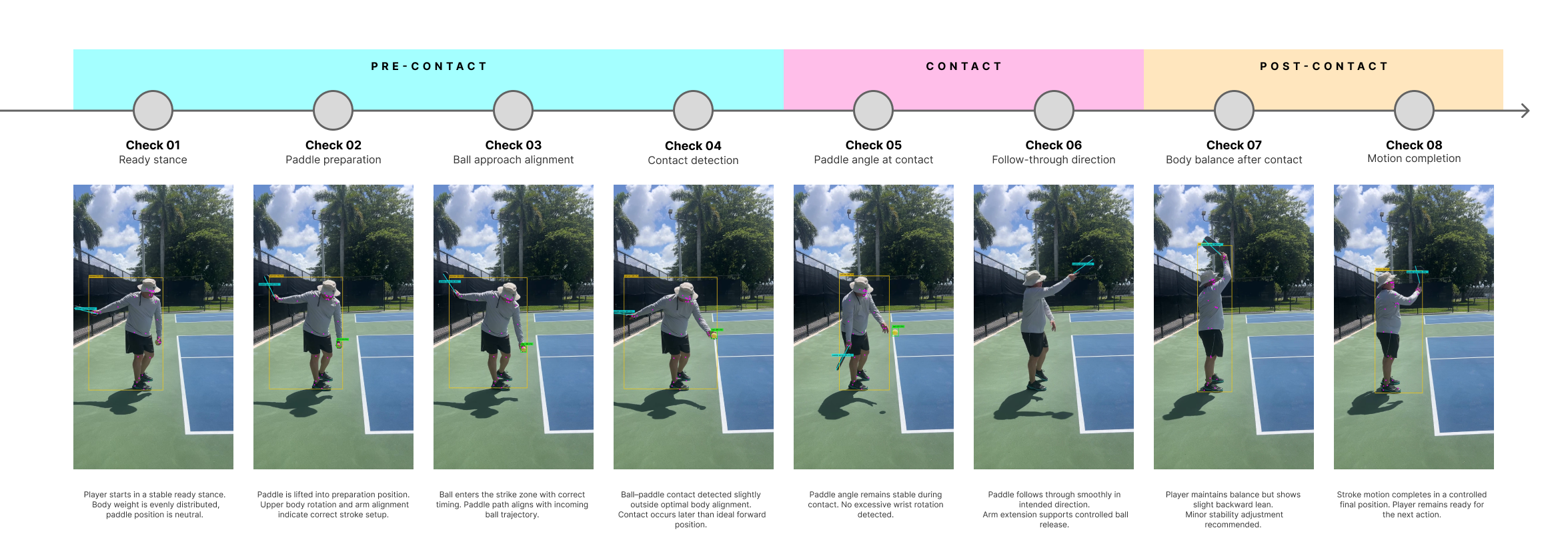
- Feedback: Users receive automated pass/fail results and actionable feedback through the app
What is the best approach to building production-ready Vision AI?
Phase 1: Core Infrastructure, Video Processing, and Serve Skill Analysis
Build the foundation of the PlayerU backend platform, integrate EyePop.ai SDK, implement core serve skill evaluation logic, and provide basic analytics and health monitoring.
- Infrastructure setup
- Video processing pipeline
- Serve skill algorithm (core feature)
- Monitoring and health
- Multiframe processor and feedback
- Additional skill implementations
Phase 2 - Advanced Skill Expansion and Performance Refinement
- Extend the system with additional skill analysis modules, improve scoring models, and refine feedback algorithms.
- Skill 5 — Overhead Hit Implementation
- Performance Optimization
- Reporting & Observability Enhancements
Project Deliverables
Phase 1
- Deployed backend infrastructure with EyePop.ai integration.
- Serve skill evaluation algorithm (v1) with full reporting.
- Monitoring and alerting pipeline live on AWS CloudWatch.
- MVP for video-based motion analysis and scoring.
Phase 2
- Overhead hit skill evaluation live and validated.
- Optimized processing pipeline with reduced latency.
- Extended analytics for performance tracking and skill progression.
What technologies are used to build AI video analysis for pickleball?
- Backend: Node.js/Nest.js with TypeScript, REST API, and a custom integration layer for the EyePop.ai SDK.
- Cloud & DevOps: VPC, ECS, ECR, S3, CloudWatch, EC2, ALB, CertificateManager with Jenkins CI/CD and secure IAM-based access control.
This project reflects how Ardas approaches AI development: combining robust engineering with practical AI systems that work in real environments. You can explore our full AI development capabilities here.
How can AI video analysis create real value in training apps?
Turning Vision AI into a production-ready feature is rarely about the model alone. It’s about integrations, edge cases, scoring logic, latency, and making the output reliable enough for real users.
If you’re building something similar — video analysis, motion tracking, technique evaluation, or any product where computer vision drives core value — we can help you ship it faster and with more confidence.
Ardas work with EyePop.ai gives teams a shortcut: fast, accurate CV outputs + the engineering muscle to turn them into polished product features.
Future-proof your product with Vision AI
If you’re serious about adding Vision AI capabilities this year, let’s talk.
FAQ
What is Vision AI in sports video analysis?
Vision AI uses computer vision and machine learning to analyze video footage, automatically detecting, tracking, and interpreting player movements and actions in sports contexts.
Why is Vision AI important for sports tech products?
It enables automated performance insights, objective skill evaluation, and scalable feedback loops that were previously manual, time‑consuming, or inconsistent.
What challenges do teams face when building Vision AI for production?
Teams must address data quality, model precision, edge‑case variability in real video captures, and seamless integration with backend pipelines.
How do sports apps benefit from automated video analysis?
They can provide real‑time or near‑real‑time technique assessment, personalized coaching guidance, and meaningful performance progression metrics.
What are the challenges of adopting AI in SaaS?
Common challenges include data quality, integration with legacy systems, regulatory compliance, and ensuring reliable AI outputs. Selecting production-ready tools and defining governance frameworks mitigates these risks.
What technologies are typically used in sports video AI systems?
Systems combine object detection, pose estimation, tracking models, video processing frameworks, and backend APIs to scale analytics across users.
What are best practices for deploying Vision AI features into production?
Prioritize robust infrastructure, monitoring/observability, latency optimization, edge‑case handling, and continuous evaluation of model performance in the wild.