
LA Tech Week 2026: Verification Is the New Bottleneck for AI Agents

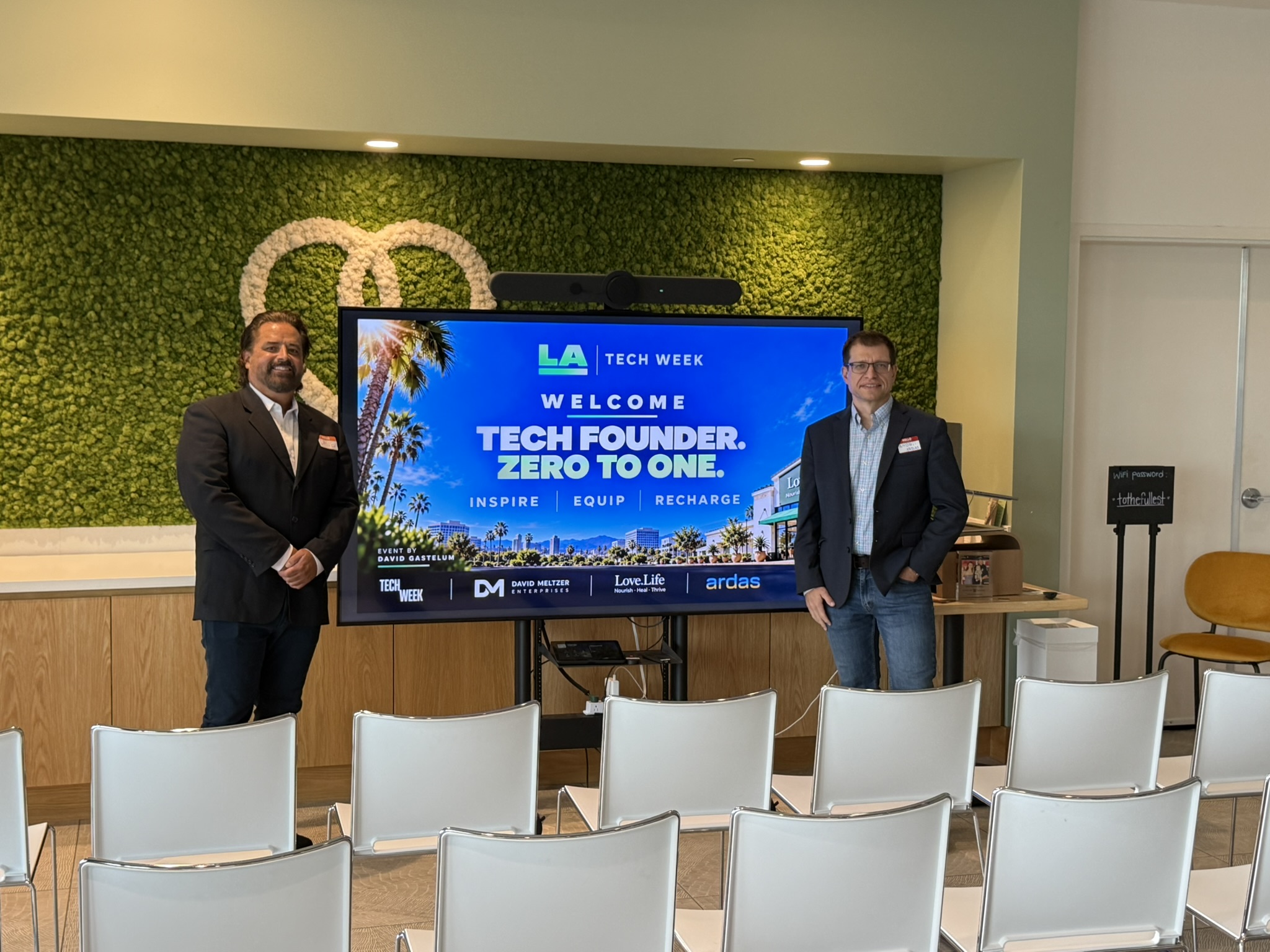 Image: Tech Founder, Zero to One: Inspiring and Equipping the Founder, with David Gastelum of DASH Memories
AI agent verification was the quiet theme of LA Tech Week 2026. Our CEO, Andrii Ryzhokhin, spent five days in eleven rooms, from founder dinners on the beach to a testing talk in a Torrance brewery. Model names came up less than you would expect. The questions people kept asking were about trust, ownership, and proof.
Writing code got cheap this year, proving that it works under real faults and real load did not. This article collects what the week showed us, unpacks one talk on invariants that deserves more than a recap, and adds comments from the Ardas engineers who run agent pipelines in production every day.
Key Takeaways
- At LA Tech Week 2026, trust came up in more rooms than any AI model name, from healthcare builders to media panels.
- The agentic AI conversation has moved from what agents can generate to what they can decide and do in production.
- Verification is the new bottleneck for teams using AI coding agents: generating code is cheap, proving it correct is not.
- Invariants, short statements of what must always be true about a system, work as executable specs that both engineers and coding agents can follow.
- Deterministic simulation testing injects real faults on purpose and replays every failure exactly, which turns rare bugs into reproducible ones.
Where We Spent LA Tech Week 2026
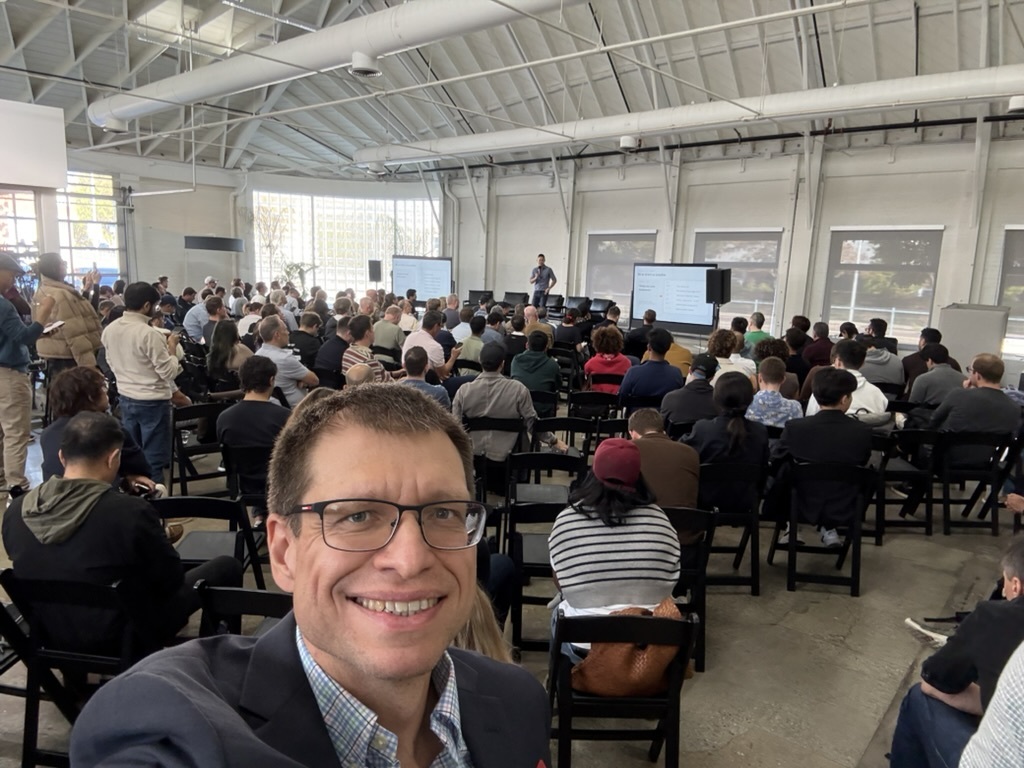
Image: AI Orchestration Agents and the Human Bottleneck with Chris Sheng, Growth Advisor at Mucker Capital and CEO of LeadrPro
We covered 11 events in five days, and three of them were our own.
Here is the full route:
- Mon, Oct 12: Tech Founder, Zero to One · AI Orchestration Agents and the Human Bottleneck · The LA Grind: Beachfront Founder & VC Dinner
- Tue, Oct 13: F**kup Night: AI-Native Across 150 Engineers (hosted by Ardas)
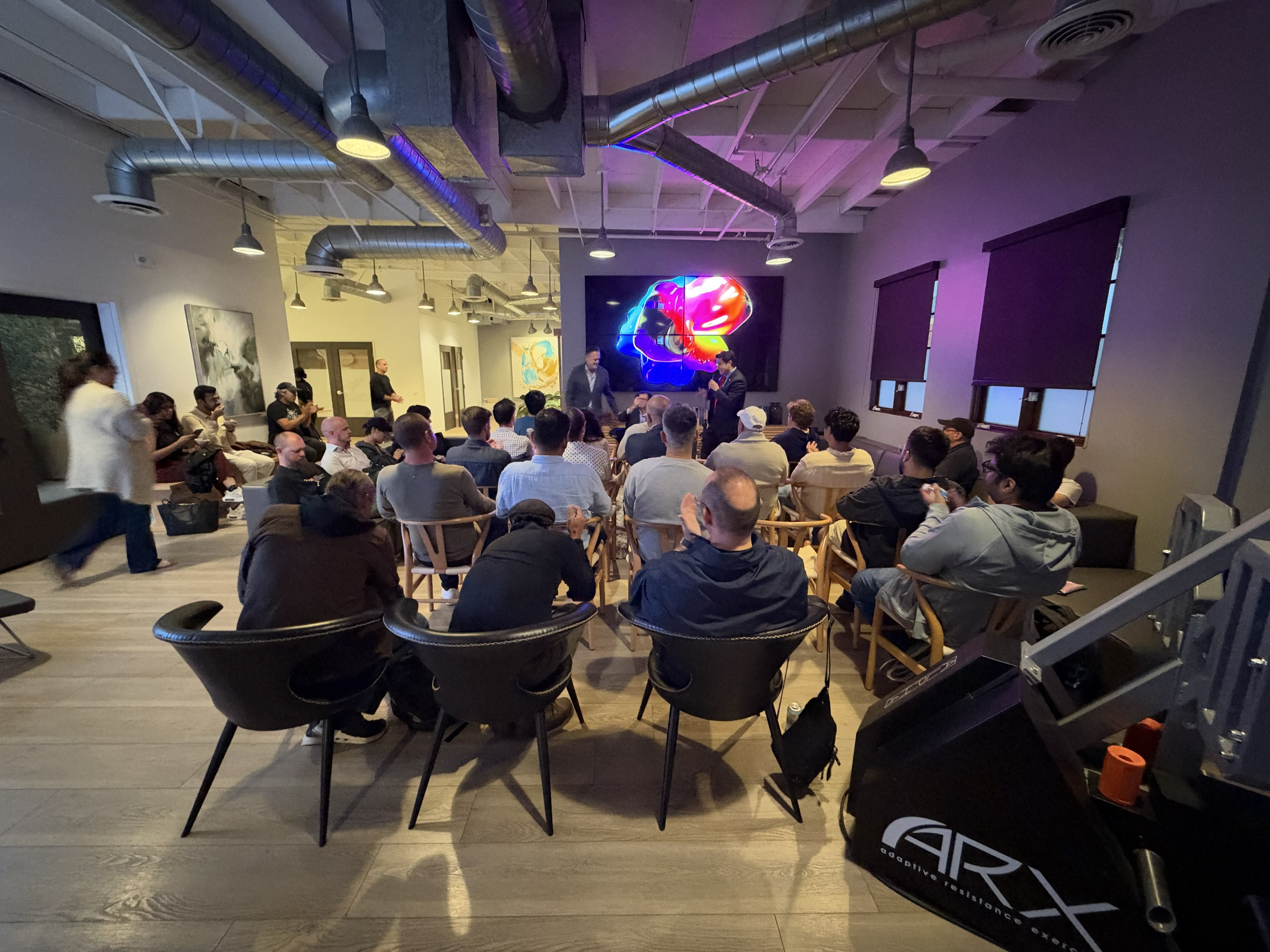
Image: Ardas F**kup Night at LA Tech Week 2026: attendees listening to a talk on going AI-native
Our own F**kup Night, AI-Native Across 150+ Engineers, was built around one idea: talk openly about what broke. Before the evening, attendees sent us more than 50 questions about running agents in real delivery, and the Ardas engineer comments in this article come from our answers to them.
Our partners at Mission Matters covered the conversation with Andrii in How AI Is Transforming Software Development and Business Growth.
The full session recording is on YouTube.
- Wed, Oct 14: Generative vs. Agentic AI · Tech Media Mixer
- Thu, Oct 15: Bugs & Brews · Kolo Founders Tech Mixer
- Fri, Oct 16: AI LAX Summit: Culture Meets AI · Trustworthy AI Social by PAC · A+ Mixer
The rooms were very different.
A founder circle, a regulated-industry panel, and a testing meetup with pinball machines do not usually share an agenda. Still, the same few questions surfaced in almost all of them.
Watch LA Tech Week 2026 Recap on Ardas Youtube channel.
Network Insight: In Person Still Wins
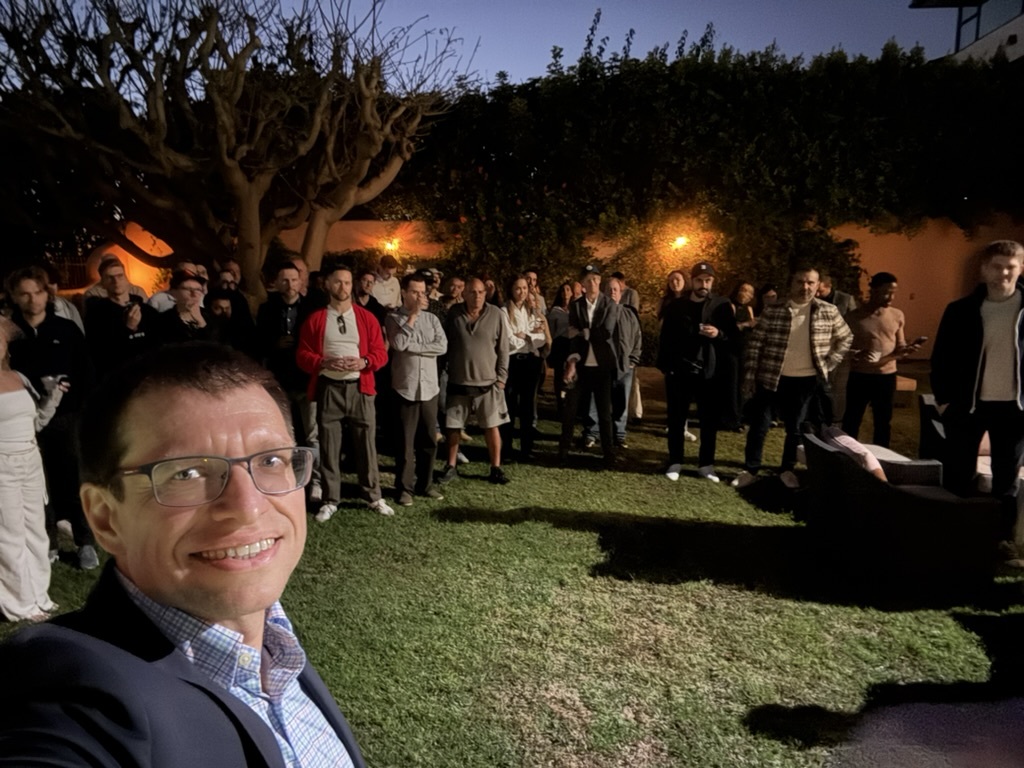
Image: The LA Grind: Beachfront Founder & VC Dinner
Some of the best conversations of the week happened offstage.
Kolo's first founders circle, and the A+ Mixer for founders who had already raised, were where people talked openly about what broke.
Thank you to every organizer and speaker who opened their doors.
Why Did Trust Come Up More Than Any AI Model?
Because the people buying and building AI now care less about what a model can do and more about whether they can rely on it. Healthcare builders working in regulated industries asked it one way. A media panel on gaining trust with AI asked it another. The question underneath stayed the same: can I rely on this?
That matches what we see with clients.
Trust in an AI feature rarely comes from the model. It comes from the controls around it:
- Data boundaries. Decide what each tool may see before anyone connects it. Agents get scoped, read-only access by default.
- Named ownership. Every AI-produced change has one owner who can explain it later.
- Audit trail. Every tool call that touches a sensitive system is logged.
- Proof before promises. Buyers trust case studies, security credentials, and a low-risk first step more than a feature list.
Regulated industries feel this first. When we added an AI Q&A chatbot to a cloud content hub for doctors across Scandinavia, clinicians got natural-language search across more than 7,000 expert-reviewed documents. The feature shipped without disrupting core services. That second part is what earned trust.
Ardas delivers under ISO 27001, and clients keep 100% of their IP. For teams in fintech or healthtech, our enterprise AI services start with an AI assessment that maps data exposure before any build.
Why Do Founders Find a Great AI Use Case and Still Never Ship It?
Usually because the code was the easy part. At the Generative vs. Agentic AI session, the conversation moved from what generative AI can create to what agentic AI can decide and do.
The honest follow-up came fast: why do so many good use cases stall between demo and production?
The answer we heard most often was hardening. Monitoring, fallbacks, security review, and cost limits can take as long as the pilot did. Pilots look good. Production gets expensive when teams skip that work.
We looked at this pilot-to-production gap in more detail in SaaS 2026 trends: from AI experiments to production-ready platforms.
Comment from Andrii Matiushenko, AI expert at Ardas:
"On one project, agents wrote the code for a login proof of concept across 4 repos in about 45 minutes of unattended work. The security review and fixes, third-party console setup, secrets and the staged user migration were each separate, human-gated steps. Writing the code was the shortest stage."
Agents are already capable of long, unattended work inside a sandbox. They can take a ticket from plan to a reviewed, tested pull request and work through batches of tasks for hours. People still choose the work, merge, deploy, and own production.
Good First Use Cases for Agents
Pick work that is frequent, well-defined and quick to check. In engineering, that means migrations and refactors, test writing, first-pass code review and bug triage. Across the business, it means support triage, document extraction, and any job where a person copies data between systems.
Start elsewhere when a confident wrong answer is expensive, and nobody can check it quickly.
The same rule holds for AI workflow automation outside engineering. In our AI recruitment assistant for hospitality, a multi-agent system took over candidate screening and matching, and recruiters kept the decisions. If your team started with lightweight no-code automation, our guide From MVP Automation to Enterprise AI Workflow walks through the next steps.
Why Is Verification the New Bottleneck for AI Agents?
Because AI agents tend to write tests for the path they already expect to work, and the bugs that hurt customers live everywhere else. Code generation scaled this year. Review and proof did not keep up.
Research backs this up. Harvard researchers studying 718 firms found that the average time to review a pull request rose 49% after coding-agent adoption (Chen & Stratton, PDF). Our own numbers moved the same way.
Comment from Andrii Matiushenko, AI expert at Ardas:
"Across our three main repos the median PR grew from between 30 and 85 lines to between 310 and 1,100 this year, and time to merge went from minutes to between 7 and 60 hours. That showed review had become the bottleneck. So we moved the first pass to agents and kept people on the risky parts: every PR now gets specialist reviewer agents before a person looks, and the human reviewer starts from evidence."
What the Bugs & Brews Talk Got Right
One of the most useful talks of CEO's week happened at Bugs & Brews in Torrance, part of LA Tech Week.
A brewery with pinball machines hosted Adrian Hatch and the Antithesis team.
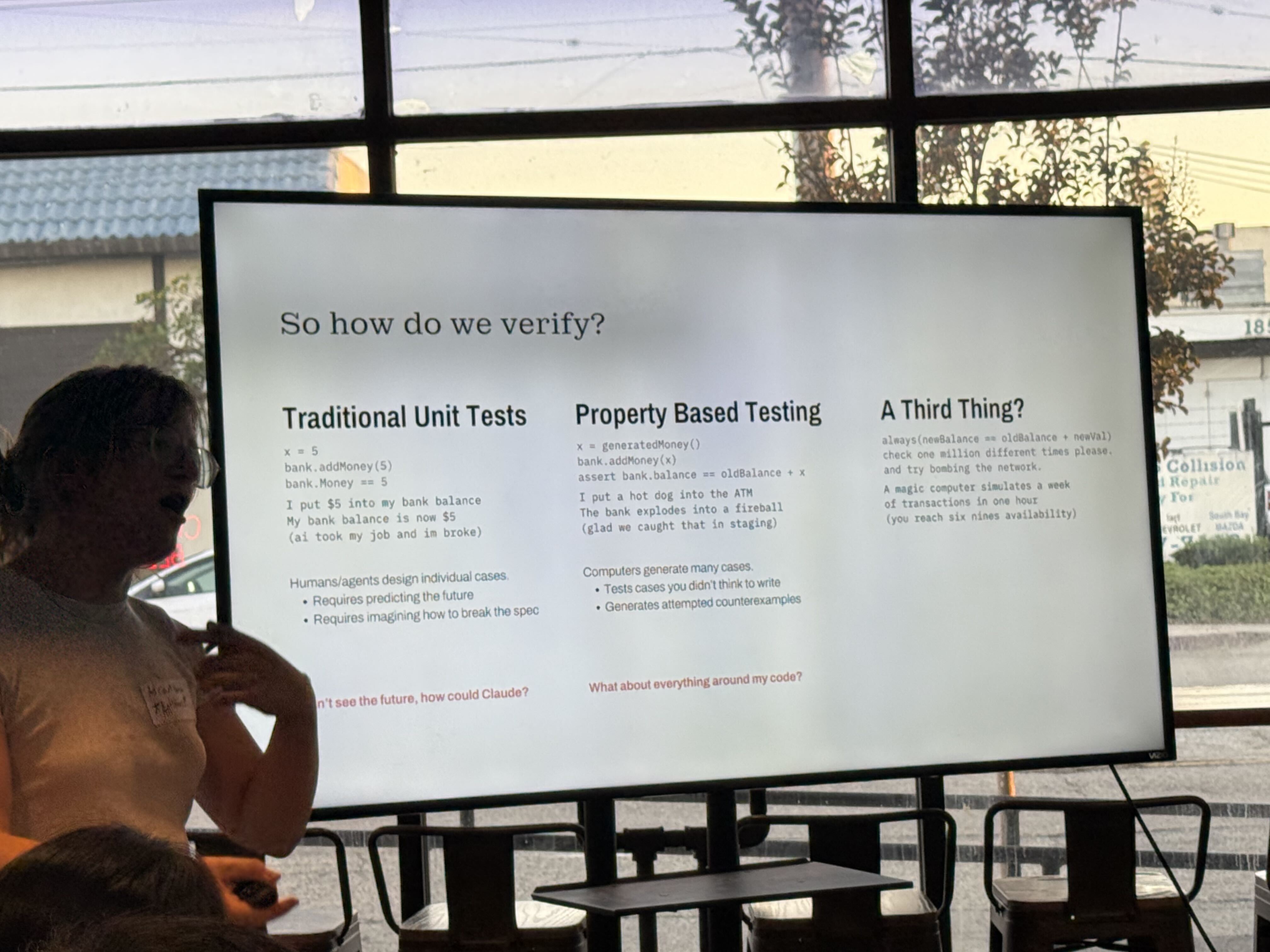
Image: Bugs & Brews: Teaching Your Agents to Fix Their Own Code. Adrian Hatch of Antithesis
Their idea is simple to say and hard to build: stop guessing every failure mode up front. Write down what must always be true about your system, then let a deterministic simulator try to break it.
Four points stood out:
- Invariants work as executable specs. "No negative balances." "Money is never created or lost." Engineers and coding agents alike can follow short statements like these.
- The environment is part of the test. Network clogs, node outages, paused threads, and even reordered CPU instructions are injected on purpose.
- Every failure replays exactly. You rewind to the moment it broke and confirm the fix. You stop hoping the bug is gone.
- Rare bugs become findable. The example that sold Andrii Ryzhokhin was a split-brain bug in etcd, the store behind Kubernetes. It appeared only with a frozen leader, a delayed heartbeat, and a clogged network at once. The fix was small. Finding it was the hard part. The etcd maintainers describe their work with Antithesis in their own write-up.
Why Green Tests Can Still Lie
A passing test suite proves less than it seems when an agent wrote both the code and the tests. Our engineers have seen this up close.
Comment from Andrii Matiushenko, AI expert at Ardas:
"We found three ways our own test runs reported green while checking nothing: an exit code lost through a shell pipe, a parser that read 'all failed' as 'nothing ran', and a test filter that matched nothing and exited cleanly. Now we break a guard on purpose and watch its test fail."
That is the same instinct behind invariants and fault injection. The checks need checking too. Mutation testing helps here, because it fails the build when your tests miss a deliberately broken line.
AI features inside a product need the same treatment.
When we built vision AI for a sports-tech product, we held scoring to an 80% frame-accuracy threshold and validated it on more than 1,000 real player videos before release.
Not sure your agent-written code is really tested?
Get an expert review of how your team verifies AI workflows, plus a short list of the invariants to write first.
How to Start Writing Invariants for an Agent-Driven Codebase
Start with the rules your business can never break, write them as short statements, and wire them into CI so every agent change is checked against them. You do not need a full simulation platform on day one.
These steps work for a team of 10 or 100.
- List the promises your product makes. Ask your senior engineers what would wake them up at 3 am. "A customer never sees another tenant's data." "An order is never charged twice." Those sentences are your first invariants.
- Write each one where agents can read it. Keep invariants in the repo, next to the rule files your coding agents load every session. A rule that lives only in a senior engineer's head cannot guide an agent.
- Turn each invariant into a check. Start with assertions in tests and property-based tests. For money, permissions, and tenant data, add checks that run against staging as well.
- Test the environment along with the code. Add fault injection for the failures you fear most: a slow dependency, a dropped connection, a restarted service.
- Prove your tests can fail. Break a guard on purpose and confirm the test catches it. Mutation testing on changed files keeps the cost reasonable.
- Grow the list from every incident. Treat each escaped bug as a missing invariant. Add it, review it like code, and keep it versioned.
Multi-tenant systems are a good place to begin. One missing tenant filter in agent-written code leaks data silently.
We applied tenant isolation tests to the multi-tenant enterprise client portal we built for one of our clients, where every role and organization boundary had to hold.
What This Means for Your Team
As agents write more of the code, the valuable work shifts.
Someone has to write down what "correct" means and keep it written down. Teams that treat invariants, ownership, and evidence as part of the product will ship faster with fewer 3 am incidents. Teams that measure output volume will keep wondering why delivery feels slower.
A practical place to start is a short review of how your team verifies agent-written code today. It shows where your checks are strong, where they only look green, and which invariants to write first.
Does your team keep its invariants in code, or in a senior engineer's head?
Ready to move AI agents from demo to production?
Our AI assessment maps your data exposure, your review bottlenecks, and the checks you need before you scale.
FAQ
What is AI agent verification?
AI agent verification is the work of proving that what an AI agent produced is correct before it reaches customers. For coding agents, it covers tests written from acceptance criteria, invariants, fault injection and human review of risky changes. It answers one question: can we rely on this output?
Why is verification the bottleneck for teams using AI coding agents?
Agents generate code far faster than people can review it. Harvard researchers studying 718 firms found pull request review time rose 49% after coding-agent adoption. At Ardas, median time to merge grew from minutes to hours as agent-written PRs got larger.
What are invariants in software testing?
Invariants are short statements of what must always be true about a system, such as "no negative balances" or "a customer never sees another tenant's data". They work as executable specs. Engineers and coding agents can both read them, and tests can check them on every change.
What is deterministic simulation testing?
Deterministic simulation testing runs your system in a controlled simulator that injects faults on purpose, such as network clogs, node outages and paused threads. Because the run is deterministic, every failure can be replayed exactly. Antithesis used this approach to find a rare split-brain bug in etcd.
How should teams review pull requests written by AI agents?
Match review depth to risk. Let reviewer agents and CI handle the first pass on routine changes, and have engineers read evidence such as test results and impact reports. Code touching auth, payments, tenant data or architecture still gets a line-by-line human read, and one named engineer owns every merge.
Which metrics show whether AI agents are improving delivery?
Track outcomes at team level. Useful metrics include time from first PR to staging per feature, time from PR open to merge, PR size and production hotfixes per commit. Lines of code and PR counts rise with agents and say little about quality.
How do you make AI workflow automation safe for production?
Start with a process that already works, then automate it. Give agents scoped, read-only access by default, log every tool call that touches a sensitive system, and require a person to approve deploys and production writes. Add a check for every failure that escapes.
What were the main themes of LA Tech Week 2026?
Trust in AI systems came up more often than any model. Other recurring themes were agentic AI moving from demos to production, verification as the new bottleneck, and the value of in-person founder conversations.
How can Ardas help verify AI agents and workflows?
Ardas is an AI-first software partner with 20+ years of SaaS delivery and ISO 9001 and ISO 27001 certification. We are working toward an Anthropic partnership and n8n Expert Partner status. We run agent pipelines with human merge gates on our own projects. An AI assessment or architecture review is the usual first step: ardas-it.com/ai-enterprise.