
What Is AI Orchestration? The Missing Layer Enterprise AI Needs to Scale

AI orchestration is the coordination layer that manages how models, agents, APIs, and workflows interact in production - governing execution order, context, retries, and governance so intelligent systems don't fail silently at scale. Most AI pilots don't fail because the model is wrong. They fail because this layer was never built.
Key Insights
- AI orchestration serves as the control layer for enterprise AI. Successful scaling depends on coordination, monitoring, and governance, not solely on improved models.
- Integration alone is insufficient. Static system connections break down when intelligent agents introduce probabilistic decision-making and context dependencies.
- Production reliability is a key competitive advantage. Features such as retry logic, observability, and distributed execution determine whether AI can handle real-world demands.
- Governance is now an architectural necessity rather than a compliance formality. RBAC, audit trails, and execution controls safeguard both revenue and reputation.
- Agent-based systems add architectural complexity. Coordinating multiple agents requires structured orchestration to prevent cascading failures.
- Ownership is a key organizational differentiator. Clear accountability for AI workflows helps maintain trust within technical teams.
- Infrastructure discipline must replace a culture of experimentation. Enterprises that treat AI as core infrastructure transition from pilots to robust systems more quickly.
- AI transformation is fundamentally architectural rather than feature-driven. Sustainable value arises when orchestration is integrated into platform design.
Most AI systems perform well in demonstrations, but often struggle under real user demands and production loads. Retries fail silently. Context disappears. Agents misfire. Teams lose trust.
The primary issue is rarely model quality; it is typically architectural.
Enterprise AI requires orchestration - not just integration. This isn’t new insight at Ardas. In our article on workflow automation for smarter AI-driven product development, we explored how automation becomes foundational for reliable AI systems, not a nice-to-have. And orchestration is the infrastructure layer that turns prototypes into production reality.
These failures aren’t edge cases; they’re predictable outcomes of architectures designed for deterministic systems.
What Is AI Orchestration?
To put it simply, AI orchestration is the coordination layer that manages how models, agents, APIs, data sources, and workflows interact in real time. While traditional automation connects systems, AI orchestration coordinates intelligence across them.
AI orchestration acts as a control plane for intelligent systems, governing how decisions are executed, observed, and corrected over time. It handles:
- Multi-step AI workflows
- Agent-to-agent communication
- Context persistence
- Retry and fallback logic
- Observability
- Governance and access control
This evolution from automation to intelligence production is exactly what we’ve been tracking in our recent blog article on SaaS 2026 trends: From AI experiments to production-ready platforms — where we highlighted that scaling AI isn’t about models alone, but about operational discipline.
How This Differs From Traditional Integration
The difference between integration and orchestration is not a technical nuance — it’s a change in system responsibility.
Traditional integration asks:
“How do we connect System A to System B?”
AI orchestration asks:
“How do we coordinate multiple intelligent systems that reason, adapt, and depend on each other?”
Below is a comparison table:
|
Traditional Integration |
AI Orchestration |
| Static workflows | Dynamic decision paths |
| Predefined triggers | Context-aware execution |
| Simple data passing | Stateful coordination |
| Limited monitoring | Full observability & governance |
| Deterministic logic | Probabilistic AI behavior |
This shift mirrors the move from script-based automation to distributed systems engineering.
Bottom line: Integration connects pipes. Orchestration manages behavior.
Our article on Ardas joining the n8n Expert Partnership Programme unpacks why partnerships with orchestration platforms matter — they help enterprises get beyond brittle point solutions.
What Is AI Agent Orchestration?
As enterprises successfully adopt agent-based designs, complexity rises. In SaaS platforms, agent orchestration prevents localized intelligence from causing systemic instability.
AI agent orchestration manages:
- Multiple specialized agents (reasoning, execution, summarization)
- Safe escalation paths
- Budget and throttling controls
- Auditability & compliance
In enterprise contexts, this layer isn’t optional. It’s about risk management. Our work in vision AI helped demonstrate similar orchestration needs in physical contexts. In building vision AI into production (video analysis for sports tech), we saw early that model capability isn’t enough — robust pipelines, monitoring, and operational design are.
Where Orchestration Typically Lives in the Architecture
In production SaaS platforms, AI orchestration typically functions as a control plane between core business systems and AI execution layers. It connects models, agents, APIs, and data sources while enforcing execution order, state management, retries, and governance policies.
This layer is often implemented using workflow engines and event-driven workflow orchestration platforms such as n8n, which allow teams to coordinate complex AI workflows without hard-coding logic into application services. Importantly, orchestration is not tied to individual features or teams — it operates as shared platform infrastructure.
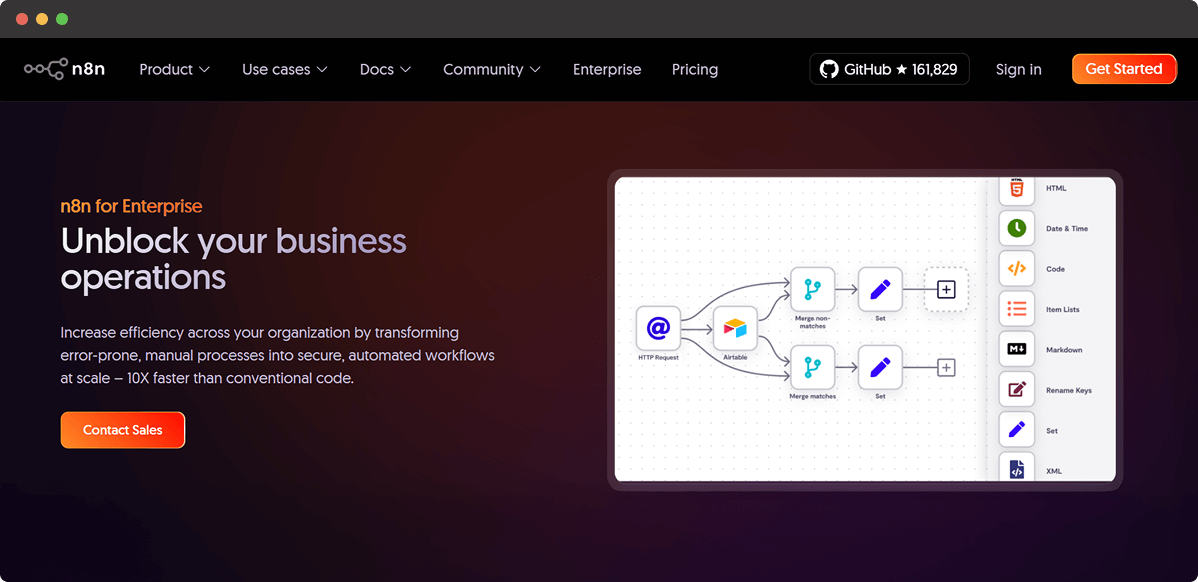
Treating orchestration this way enables SaaS companies to scale AI reliably without embedding intelligence directly into brittle application logic.
Why Enterprise AI Fails Without Orchestration
From our vast experience across fintech, logistics, healthcare, and other SaaS platforms, failure typically starts at the same place(s):
- No clear workflow ownership
- No retry or fallback logic
- No centralized observability
- Fragmented data sources
- Lack of governance controls
- Pilot architectures used in production
Individually, these appear to be implementation gaps. Together, they indicate the absence of an execution control layer.
AI quickly touches revenue processes.
When your working systems break, trust evaporates — as we outlined in our strategic view on from digital to AI transformation, where organizational realignment and operational systems must accompany technology shifts. AI without orchestration is like deploying microservices without proper deployment and monitoring tooling — theoretically possible, practically fragile.
What Production-Grade AI Orchestration Requires
Across enterprise implementations, these capabilities consistently separate experimental AI from production-grade systems.
1. Workflow Control Layer
Pipelines with versioning, retries, branching, and rollback support.
2. Observability
Real-time metrics, logging, tracing, and alerting.
3. Governance
RBAC, secret management, audit logs, and compliance integration.
4. Scalable Execution
Distributed processing, queueing, and horizontal scaling.
5. Human-in-the-Loop
Approval checkpoints and escalation paths where risk is high. This framework reflects what we recommend in enterprise readiness engagements. AI isn’t a “feature” — it’s infrastructure that must scale like core platforms.
Below are just some examples of use cases from our real-world projects. The list is not final, of course. They all have one thing in common: each requires orchestration, not just connectivity.
Enterprise Use Cases That Demand Orchestration
These use cases fail fastest when orchestration is missing because they combine AI decisions with revenue, compliance, or real-world execution.
Fintech
Real-time fraud detection blending multiple models with business rules.
Healthcare
Claims processing and clinical support systems require governance and traceability.
Logistics
Route planning with real-time sensor data, optimization loops, and billing systems.
SaaS Products
Embedded copilots that integrate with CRM, analytics, and product telemetry. Let’s see how we, as an expert dev team, can help your business.
How Ardas Designs Enterprise AI Architecture
At Ardas, we approach AI orchestration as part of enterprise system design, not as an add-on. Our work starts where most AI initiatives stall: at the boundary between intelligent systems and enterprise operations.
We combine:
- Enterprise AI strategy and roadmap
- Robust orchestration and control layers
- MLOps/LLMOps pipelines
- Scalable APIs and workflow engines
- Vector databases for context and memory
- Secure cloud deployments (AWS/Azure/GCP)
- GitOps-driven infrastructure automation
- Monitoring, alerting, and resilience
This echoes the shift from experimentation to production-ready platforms that we’ve been chronicling across our blog — from workflow automation to SaaS trends to full AI transformation frameworks.
Final Takeaways
AI orchestration is not a trend. It is the missing layer between experimentation and enterprise scale.
If your AI:
- Works in demos but crumbles in production
- Lacks monitoring and retry logic
- Has unclear ownership
- Doesn’t scale safely
You don’t have an AI problem.
You have an orchestration gap.
Moving from AI Pilot to Production?
Let’s discuss how orchestration fits your roadmap
FAQ
What is AI orchestration?
It's the coordination layer that governs how AI models, agents, and workflows interact in production — managing execution, monitoring, and governance so systems don't fail unpredictably at scale.
Why do AI pilots fail when moving to production?
Most AI pilots are built without observability, retry and fallback logic, clear workflow ownership, or governance controls. When real traffic, edge cases, and operational load appear, these architectural gaps surface immediately. Ardas addresses this by designing production architecture from the start — not retrofitting it after a pilot breaks.
What is AI agent orchestration?
AI agent orchestration coordinates multiple specialized agents by managing task delegation, tool access, shared context, safe interruption and resume, and execution limits. It enables enterprises to run complex, multi-step AI workflows reliably and safely in production.
Does every company need AI orchestration?
Not every company, but any organization scaling AI beyond isolated experiments should consider it. When AI impacts revenue, compliance, customer experience, or core operations, orchestration becomes essential infrastructure rather than an optional layer. Ardas recommends evaluating orchestration needs as soon as AI workflows touch production data or customer-facing systems.
How can we tell if we have an AI orchestration gap?
Common signals include AI workflows failing under load, lack of centralized monitoring, missing audit trails for AI decisions, frequent manual fixes, and declining trust from internal teams. If your engineers are manually retrying failed AI steps or patching outputs before they reach users, you do not have an orchestration layer — you have a fragile process held together by human intervention.
Who helps SaaS companies scale AI from pilots to production?
SaaS teams typically need tech partners who combine AI architecture, workflow orchestration, and platform engineering expertise — not just model development. Ardas helps post-MVP and enterprise SaaS companies design orchestration layers, observability, and governance to run AI reliably in real production environments.